

Underwriting Fear
A Framework for Managing Emotion in Investing

Substack — Premium Deep Dive | February 20th, 2026
Everyone has a thesis when markets are calm.
Very few people can execute it when the headlines are screaming.
This week, we closed on the Imperial Arms — a 117-year-old apartment building in Portland, Oregon. A city that, depending on which corner of FinX you inhabit, is either “recovering nicely” or “functionally over.”
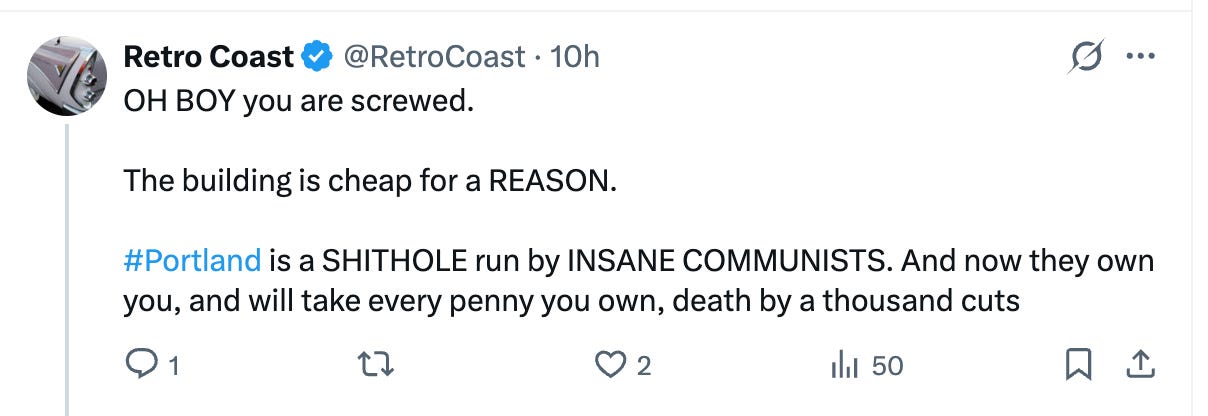
Here’s a live response I got to this deal on X. Always a place of great civility.
We paid a 7.2% going-in cap rate on our (conservative) expense load. The building has a new boiler, new roof, new windows, and upgraded panels. Replacement cost runs north of $400/sqft. We bought vintage at a fraction of that.
And there is a vocal segment of people who feel and say some derivative of the above. Or have zero experience in the market, but feel inclined to tell me why it was a terrible idea. Ideologically driven, one and all. But also - fearful.
Also, the irony of being told about Portland by somebody with an “anonymous” name who may or may not have any professional experience in real estate, or even in Portland. But that’s the state of public investing narrative today.
So I want to pull back the curtain on how we actually think through a deal like this — when the narrative is negative, when the fear is real, and when most capital is sitting on the sidelines waiting for “more clarity.”
Because clarity, in my experience, arrives right after the best entry points have closed.
The Problem With Waiting for Confidence
There’s a seductive idea in investing that you should wait until you’re sure before you act.
The problem is that certainty and opportunity are almost perfectly inversely correlated.
In 2021, everyone was certain about Sunbelt multifamily. Cap rates compressed to 3–4%. Syndicators were raising money faster than they could deploy it. The conviction was nearly universal.
You know what happened next.
Contrarian investing isn’t about being contrarian for its own sake — that’s just being difficult. It’s about having a framework rigorous enough that you can act when the sentiment is negative, but the fundamentals are sound.
That framework is what I want to share today.
The Five-Filter Underwriting Model
When I’m looking at a deal in a fear-driven market, I run it through five filters — in order. If it fails any one of them, I stop.
Filter 1: Is the fear sentiment or structural?
This is the most important question, and most investors skip it entirely.
Fear comes in two flavors:
Sentiment fear — the market feels bad. Headlines are negative. Investors are nervous. Capital is cautious. But the underlying fundamentals (supply, demand, employment, rent trends) are intact or improving.
Structural fear — something has actually broken. Population is leaving and not coming back. The employment base has hollowed out. Supply is coming in waves with no absorption in sight.
Sentiment fear creates opportunity. Structural fear is a warning.
