


Note to our paid subscribers: I end this article with some serious take-aways for any investor worth their salt, and include a personal war story that matters (a great deal) for how to think about investing (and how it could have [but did not … ] given me a serious case of personal bankruptcy).
Also: we also recorded a stand-alone YouTube video for this. That article is linked at the end. Let me know what you think!
I want to start with an uncomfortable observation about the people who got destroyed in multifamily between 2022 and 2024.
The kicker here is that almost nobody was wrong on their long-term thesis.
They believed America had a structural housing shortage. Which, I would argue, was and is true. They believed rents in the Sun Belt would grow. They did, for a time. They believed apartments were among the most durable cash-flowing assets available to a private investor. Also true, and still true today (I think). If you had handed their 2021 investment memos to a disinterested analyst and stripped the dates off, most would read as sober documents making defensible claims about the physical world.
The assets performed (some better, some worse), but the sponsors were wiped out anyway in many cases.
I’ve watched this from close range for four years now, and the thing that stays with me isn’t the schadenfreude. It’s how little the quality of the thinking mattered. The people who survived and the people who didn’t held nearly identical views about apartments. What separated them was something more intrinsically important to successful real estate investing.
Look - in life and investing, we are usually proven right (eventually). What separates the survivors from the losers is simply a matter of whether they can afford to wait until they’re proven right.
I’d argue this is a sufficiency problem. We spend a lot of our analytical effort on the question of is this particular thesis correct? Less time, unfortunately, is spent analyzing what is the maximum pain duration this position can survive. The second one determines a lot more outcomes than people want to admit.
This is why Sam Insull’s story is particularly informative. As always, on The Timeless Investor, we try to mine history for particularly informative stories that can strengthen us in the here-and-now as investors.
You see, Sam Insull was right in a bigly way. He just couldn’t endure.
And a man who had once been one of the wealthiest and most powerful men in America died on a subway platform with eighty-four cents in his pocket. And they had to use his laundy receipt to figure out who the heck he was.
This is one of the epic rise and fall stories in American history.
Our Socials: for those of you that don’t follow us on other channels …
Perhaps the most successful prediction in American business history
At the core, Samuel Insull’s problem was that ultimately he was correct about everything.
He arrived in New York in 1881 at twenty-one, a London clerk’s son whose one marketable skill was shorthand, and that skill got him hired as Thomas Edison’s private secretary. Eight years later he was running Edison General Electric’s operations. When Morgan engineered the merger that created GE and pushed Edison aside, Insull was offered a senior role in the new company and turned it down for the presidency of a struggling Chicago utility — one of twenty competing stations serving five thousand customers in a city of a million.
And the man had what I would call a “visionary” insight. The industry, as he saw it, misunderstood its own economics.
It’s sort of hard to grasp in our present era, but in 1892 electricity was a luxury good: high price, few customers, fat margins. But electricity has an odd property. Electricity is produced and consumed in the same instant and cannot be super effectively stored — so a plant sized for peak demand is a colossally expensive asset that idles most of the day.
Said slightly differently - the variable that governs profitability wasn’t actually price. It was all about utilization.
So he put his insight to work. Insull chased customers whose demand peaked when others’ didn’t — streetcars running all day while houses sat dark, industrial users pulled off their private generators. He made power cheap on purpose, wiring homes for nearly nothing, giving appliances away, cutting rates and watching volume more than compensate. Five thousand customers became fifty thousand became four million across thirty-two states.
Mind you - building the infrastructure for free to capture the business is a time honored practice. One has only to look at cable providers today to see that. We are endlessly approached by utilities looking to “install” their systems in our buildings, with the hope to then capture some market share.
Then, his “masterstroke”, if you will. A move that will look markedly similar to our current crop of AI executives.
Insull stood in front of his own industry association and argued that electric utilities should be regulated — that competition in wires was wasteful, duplicated infrastructure was insane, and the correct structure was an exclusive franchise with rates supervised by a state commission.
Didn’t Peter Thiel make a similar argument in Zero to One, arguing that competition is actually contrary to the good of a company? Which makes sense. Just maybe makes less sense for the consumer.
Now, to be clear, Insull was NOT being altruistic. He was buying something: protected territory, a guaranteed return, and above all permission to build on a forty-year horizon.
The reality is that when you have to outlay massive amounts of money, your enemy isn’t regulation. It’s uncertainty. Remove the uncertainty, and you are permitted to make 40+ year investment bets.
That bargain became the architecture of American utilities and outlived him by ninety years. You are using his grid, under substantially his rules, in order to read this article.
Insull had a great thesis. He correctly read that electricity would be the defining infrastructure of the twentieth century, executed it for four decades, and built the physical thing.
But if being right were sufficient, he would likely have a national monument today.
How do you pay for this thing?
Infrastructure at that scale eats capital. In 1930 alone, Insull’s companies put $197 million into new facilities.
That number needs converting properly, because inflation calculators badly understate what it represents. US GDP in 1930 was roughly $92 billion. So a single year of capex ran about 0.21% of the entire American economy — call it $60 billion in today’s terms, from one man’s group of companies.
The issue with infrastructure buildouts is they almost require bubble economics. They are enormous, costly, and prohibitive. We’ve hit upon the following articles, which if you want a refresh I’ve linked below. You could say infrastructure is a passionate interest of mine, because it’s a) so useful and important and b) such a horrific quagmire.


So back to the capital source. Insull could have raised it on Wall Street. But, he had a complicated relationship with Wall Street.
He’d watched Morgan take Edison’s company away from him, and he wanted capital that didn’t come with New York attached. So he built his own channel: he sold stock and bonds directly to his own ratepayers and employees, on installment plans, through salesmen in the field. A Chicago schoolteacher could own a piece of the company that lit her classroom for a few dollars a month.
He called it customer ownership. At peak, roughly 600,000 people held Insull equity and another 500,000 held the paper.
Now, there’s a charitable and an uncharitable reading of this.
The charitable read: he took an asset class that had been the private preserve of the wealthy and handed it to machinists and schoolteachers, twenty-five years before anyone used the word “retail investor.” He said publicly and often that a shareholder who is also a ratepayer understands the business better than any institution.
The other reading: he manufactured a permanent bid for his own securities among buyers with no capacity whatsoever to evaluate them, resting entirely on a trust relationship that had nothing to do with the merits of the paper.
I don’t think he was lying. I think he believed the first version completely, and I think that’s precisely what made it dangerous — a man selling securities he was certain were good, to people who trusted him rather than the analysis.
Arguably, most major asset management groups today are running the same playbook, almost verbatim. Democratization of access. Giving the “everyman” access to the domains of the rich and ultra-affluent. Good? Bad? I’ll leave it to you to decide. Personally, I am suspicious.
The Structural Flaw
Now, what doomed Insull wasn’t necessarily that electricity was a bad investment or that his thesis was incorrect. His thesis was (ultimately) extremely right.
It was the structure (as it always is).
The operating companies were fine. Commonwealth Edison, Public Service of Northern Illinois, People’s Gas — real businesses, real customers, real bills, for a product nobody could stop buying. Most came through the Depression intact. Several are still operating today!
What failed was the thing built on top of them.
To retain control of an expanding empire while committing almost none of his own money, Insull stacked holding companies. Power stations at the base. An entity holding their shares. Another entity holding that entity’s shares. Control the top and you control everything below. Insull Utility Investments in December 1928; Corporation Securities Company of Chicago a year later, created substantially to hold the first one’s securities.
By January 1932: more than ninety-five holding companies sitting on two hundred fifty-five operating companies.
The family’s own money in the structure was under one million dollars. It directed two and a half billion in assets — about $2,500 of other people’s capital per dollar of their own.
None of that was illegal. It wasn’t concealed; the filings existed and were transparently disclosed. It was a capital structure, and it had one property that mattered more than every other feature combined: it converted any decline in asset prices into an immediate demand for cash. Particularly when you’re heavily indebted against said stock.
The event that caused the downfall was when Cyrus Eaton, a Cleveland investor, began quietly accumulating Insull shares — at some point holding more than Insull himself. Whether Eaton wanted control or merely wanted Insull to believe he did is unknowable and irrelevant. What matters is the response.
Insull’s Chicago bankers proposed what seemed an obvious solution to his control predicament: borrow roughly $48 million and buy Eaton out.
Four times, Insull refused. He deeply understood the risk of taking on a massive leveraged position against his stock.
Then in June 1930, he said yes.
Why? Two primary reasons. Firstly - as the Great Depression was settling in, Insull’s supply of retail investors essentially evaporated. And secondly - he feared (with or without merit, it’s unclear) that Cyrus Eaton was angling to take away his life’s work.
More critically, though, consider othe position he had just constructed. A fixed obligation, in dollars, on a hard schedule. Collateralized by equity in holding companies whose only assets were shares in holding companies whose assets were power plants. The obligation measured in months, against stock positions that could (and would) decline precipitously in value.
That gap is the whole story. Not leverage — mismatch. Leverage is survivable when the term of your money exceeds the term of your plan. It is lethal when it doesn’t, and it becomes lethal on a date somebody else chooses.
The Depression didn’t destroy the operating businesses. Revenue fell; people used less electricity and rode fewer interurbans. The structure didn’t need a catastrophe. It needed a pause and a resumption of market liquidity, and it did not get one. Insull pledged his remaining stock, then pledged more, and on April 8th, 1932, the debt came due. Insull Utility Investments went from $160 a share to twelve and a half cents.
He resigned in June 1932 owing roughly $16 million more than he was worth — too broke, as one banker put it, to be bankrupt.
Roosevelt ran against him by name that autumn. He fled to Greece, was arrested in Turkey, came home in handcuffs at seventy-four, took the stand in his own defense, and was acquitted. Then acquitted again. Then a third time.
Three juries found no crime, and I think all three were right. A million people lost their savings anyway.
Our categories have room for fraud and room for innocence and no room at all for what Insull actually did — which was to build a structure so fragile that being right was not enough to protect the people who trusted him.
Congress wrote the Public Utility Holding Company Act in 1935 specifically to outlaw the shape of what he’d built. He died three years later in the Métro with eighty-four cents and a laundry bill, which is how they identified the body.
A brutal ending to an absolutely legendary career.
The Shape of Infrastructure Bubbles
What makes this worth your attention isn’t that it happened. It’s that it keeps happening, in the same form, to people who are correct.
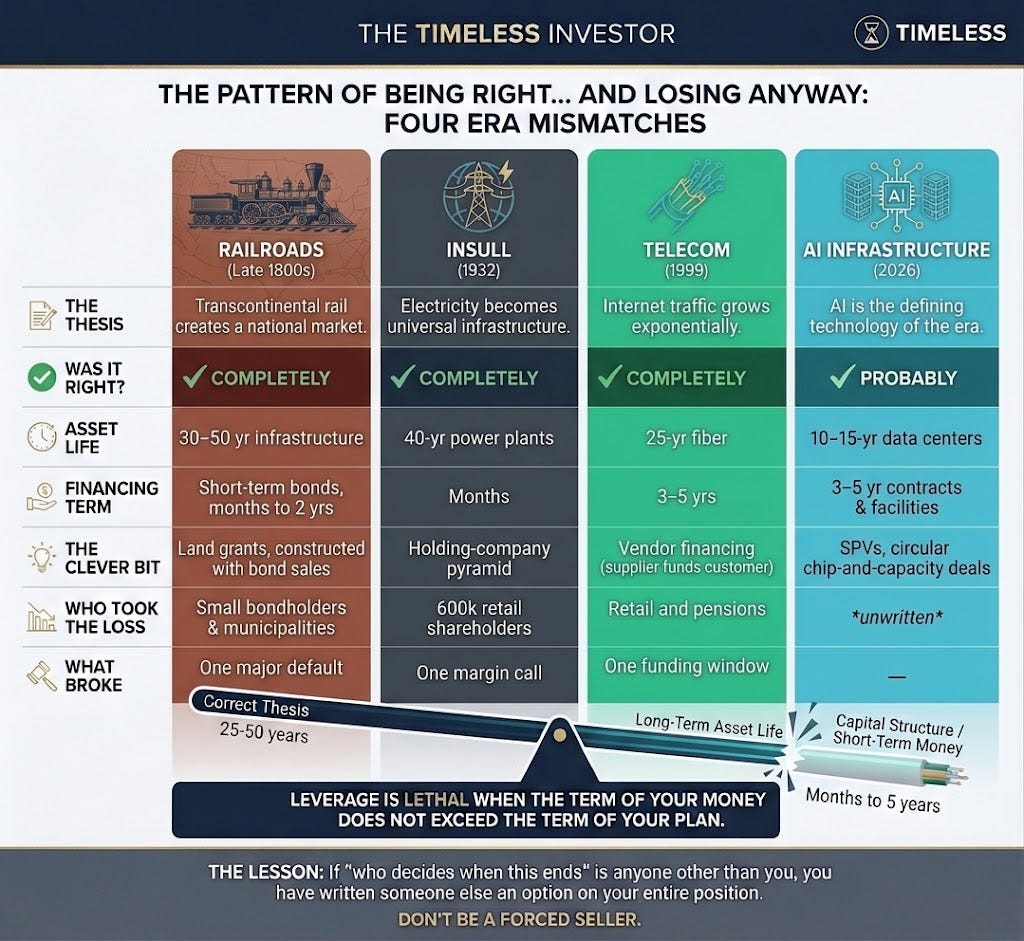
The fiber laid in 1999 is carrying this email. The railroad buildouts were, ultimately, absolutely correct. Insull’s grid today is powering the data centers. In every case the physical thesis was vindicated and the capital structure was not, because the structures were built to require that the world cooperate on a schedule.
The pattern here is not to “beware of bubbles.” Bubbles are the easy case — you can decline to participate if you sniff one out.
The pattern I’m trying to highlight here is way harder and way more cruel: the thesis is correct, participation is rational, and the structure still kills you.
A Test
So here is what I actually do with this, and what I’d ask any sponsor you’re considering.
Not is the thesis right. Assume it is. Assume you’re Insull, correct about the century.
Ask instead: what is the longest period of adversity this position can survive, and who decides when it ends?
That second clause is the one people miss. Insull’s fate was determined by a margin clerk. The 2021 sponsors’ fate was determined by whoever set SOFR and whoever priced their rate cap renewal. If the answer to “who decides when this ends” is anyone other than you, then you’ve got yourself a precarious position.
Three things follow logically from this:
Term is a feature you pay for. Longer, fixed, non-recourse debt costs real yield in every good year. That cost is not inefficiency. It’s the premium on the only insurance that matters, and you will feel stupid paying it for years at a stretch.
Reserves are not idle capital. They’re the mechanism that converts a forced decision into a chosen one. Every dollar of dry powder is a dollar that lets you say “no thank you, I’ll wait” on a date you didn’t pick.
Being unforced is a strategy, not a temperament. It (often) shows up as underperformance in bull markets and as survival exactly once, at which point it’s the only thing that ever mattered.
Insull built the American electrical grid. He was right about the most important infrastructure question of his century, for forty years, and he could not wait eighteen months.
Don’t be a forced seller.
Think well. Act wisely. Build something timeless.
— Arie
The full story — Insull’s rise, the four refusals, the trials — is this week’s video:
🔒 FOR PAID SUBSCRIBERS
Below: the four questions I now run on every deal I underwrite, the 2021 deal I turned down and what it would have done to me, and the specific tells I’m watching in AI infrastructure credit right now.
I’ll be in the comments all week my friends.
This is a very useful essay. I have been in the oil & gas, production business almost my entire working career. I get it.