

Ruin versus Volatility
What 3,000 Years of Financial History Teaches Us That Modern Finance Forgot

Every finance student learns the same definition of risk: volatility. Standard deviation. The amount a price wiggles.
I (fondly) recall studying the concept while studying for the CFA Exam(s). It was really drilled into our heads.
This idea is also about 70 years old, and is firmly entrenched as financial orthodoxy.
Before it existed — for three thousand years before a mathematician named Harry Markowitz put it on paper in 1952 — investors, merchants, and estate managers defined risk in a completely different way.
They defined it as the thing that ends you.
Not the thing that fluctuates. The thing that ruins.
This essay traces that history, explains exactly where and why the modern definition went wrong, and — most importantly — shows you what the proper definition of risk means for your portfolio right now, in this market, with these numbers.
Part I: The Original Definition (1800 BC – 1952)
Babylon: Risk as Ruin
The oldest formalized risk management instrument we know of appears in the Code of Hammurabi, around 1800 BC. It’s called a bottomry loan.

A merchant needs capital to load a ship. A lender provides the money. But the loan contains a specific clause: if the ship sinks, the debt is forgiven.
The Babylonians weren’t measuring volatility. They were pricing ruin — the probability of a total, permanent, game-ending loss. The instrument was structured around one question: what destroys you completely?
And it shouldn’t come as a huge surprise that risk management really started with maritime risk. I mean, what’s riskier than loading up a bunch of precious goods on a small wooden craft, and venturing into the ocean blue?
Not only did you have storms, pirates and the treachery of the ocean itself. But the ancient’s also thought that monsters lurked beneath the waves.
Which means that you - if you were a merchant - measured risk in terms of absolute loss. Which makes sense. Not in terms of the risk of volatility of the prices of your goods.
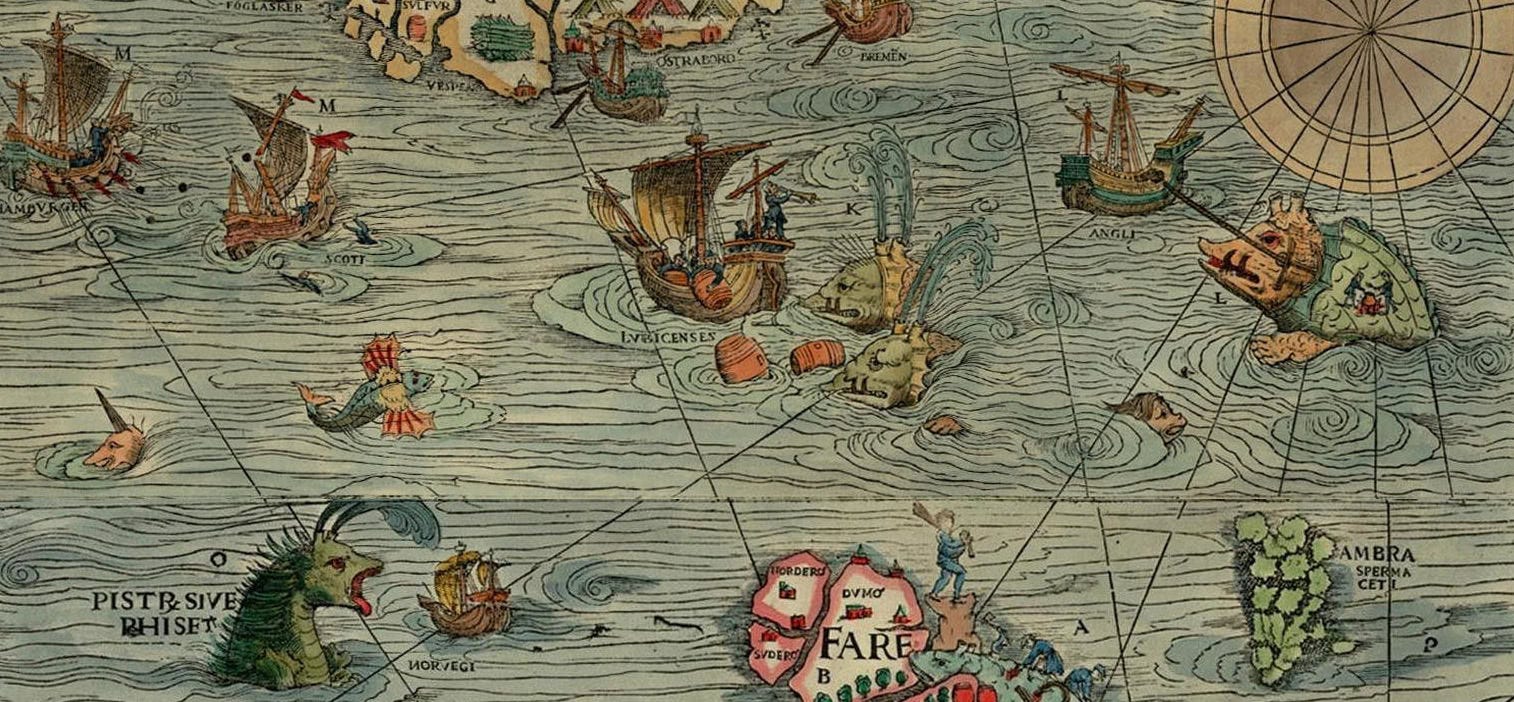
This is the DNA of every honest risk framework that followed.
The Bishop of Winchester: Risk as Concentration
Jump forward to 14th-century England. The Bishop of Winchester — advisor to monarchs from Edward III to Henry VIII — owned a diversified estate of 60 distinct manors stretching from Somerset to London.
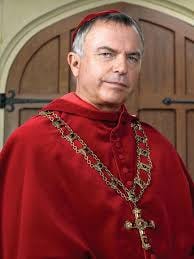
Recent historical scholarship has analyzed the Bishop’s detailed estate accounts and found something remarkable: his estate managers were practicing systematic risk diversification across geography, crop type, and income stream — 600 years before Harry Markowitz won a Nobel Prize for formalizing the same idea.1
Remember, this was well before we had any proper theories. They were doing it because they understood that concentration could (and does) destroy you. That the thing that could ruin you was having all your exposure in one place when catastrophe hit — plague, drought, war, flood.
Said differently, the medieval definition of risk: the thing that wipes out the whole position.
Lloyd’s Coffee House: Risk as Permanent Loss
In 1688, Edward Lloyd opens a coffee house on Tower Street in London. Underwriters begin meeting there to price marine insurance against shipwrecks, piracy, and fire.
This is often recalled as the start of a proper insurance industry. But can we view it as another step forward in the world of risk management?
Important point - nobody at Lloyd’s was measuring how much the price of a ship fluctuated week to week. They were asking: what is the probability this ship does not come home?
Permanent. Unrecoverable. Final.
Maritime Risk, my friends. The real risk. Your ship sinking.
Frank Knight’s Distinction: The Most Important Idea in Finance Nobody Remembers
In 1921, economist Frank Knight published Risk, Uncertainty and Profit — and drew what I believe is the sharpest distinction in the history of financial theory.

Knight separated two things that most practitioners treat as identical:
Risk: quantifiable uncertainty. You can assign a probability to it. A coin flip. A mortality table. A known distribution.
True Uncertainty: cannot be modeled or quantified. The unknown unknown. The thing you didn’t see coming and could never have priced.
Knight’s core argument: most of what investors actually face is uncertainty, not risk. It cannot be captured in a formula. It cannot be reduced to a standard deviation.
By 1930, serious economists had already acknowledged that probabilistic risk measurement was fundamentally broken for economic systems. The historical record is clear on this. The math didn’t fit the reality.
Then the mathematicians arrived. And by 1952, the problems had been quietly forgotten.
Benjamin Graham: The Last Coherent Practitioner
Benjamin Graham published Security Analysis in 1934 — writing in the wreckage of the Great Depression, when volatility was irrelevant and ruin was real.
His definition was simple: risk is the permanent loss of capital.
His entire framework — margin of safety, intrinsic value, the distinction between investment and speculation — was built around one question: how do I make sure I do not permanently lose money?
Volatility, to Graham, was largely noise. Mr. Market was manic-depressive. His price swings weren’t risk — they were opportunity. Risk was paying too much for something, watching the business deteriorate, and never getting your capital back.
Graham wrote this while people had actually lost everything. Not on paper. In reality.
And then — almost immediately — the academics arrived with something more mathematically elegant.
Part II: Where It Went Wrong — and Why It Matters
Harry Markowitz. 1952. A 25-year-old PhD student publishes a 14-page paper called “Portfolio Selection.” Standard deviation becomes the measure of risk. The math is beautiful. The efficient frontier is born.
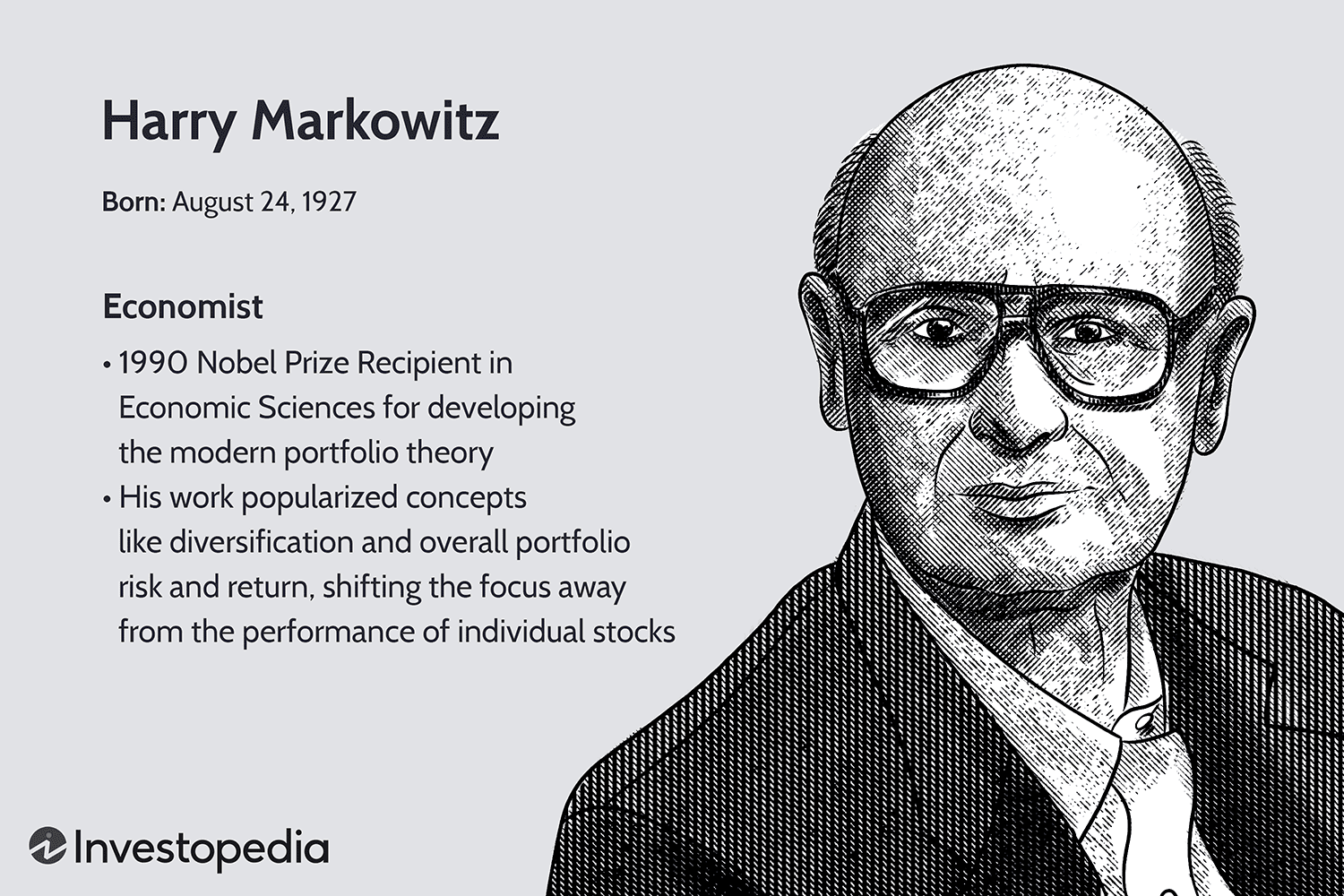
But the model requires assumptions that, for real asset investors, are simply fiction:
Markets are liquid — you can always exit
Returns follow a normal distribution — extreme events are rare
Historical volatility predicts future volatility
All investors share the same information and time horizon
For publicly traded large-cap equities, these assumptions are roughly defensible. The market is deep, you can sell in seconds, and historical data is abundant.
For private real estate — illiquid, long hold periods, operationally driven, locally priced — every single assumption is wrong.
You cannot exit at will. Returns are not normally distributed (they are fat-tailed and skewed by operational execution). Historical cap rate data tells you almost nothing about future returns in a specific submarket. And your information advantage is the edge — information symmetry doesn’t exist.
⚠️ An Insight: The practical consequence of using the wrong definition of risk isn’t merely intellectual. It systematically causes real estate investors to misprice their exposure — treating genuine danger (bad debt structure, supply-unconstrained markets, operational fragility) as manageable risk, while treating volatility (temporary price dips, negative headlines, sentiment cycles) as existential threat.
This inversion explains, more than almost anything else, why so much capital is sitting on the sidelines right now.
Part III: The Data — What the Proper Definition of Risk Reveals Right Now
From here, let’s move onto how the proper definition of risk helps us determine where to go from here as an investor.
The $7.8 Trillion Problem
As of late February 2026, US money market funds hold $7.8 trillion in assets — with total MMF assets having peaked at a record $8.18 trillion in December 2025 after attracting $935 billion in new inflows in 2025 alone. Morgan Stanley projects another $500 billion in inflows in 2026, potentially pushing the total past $8.6 trillion.
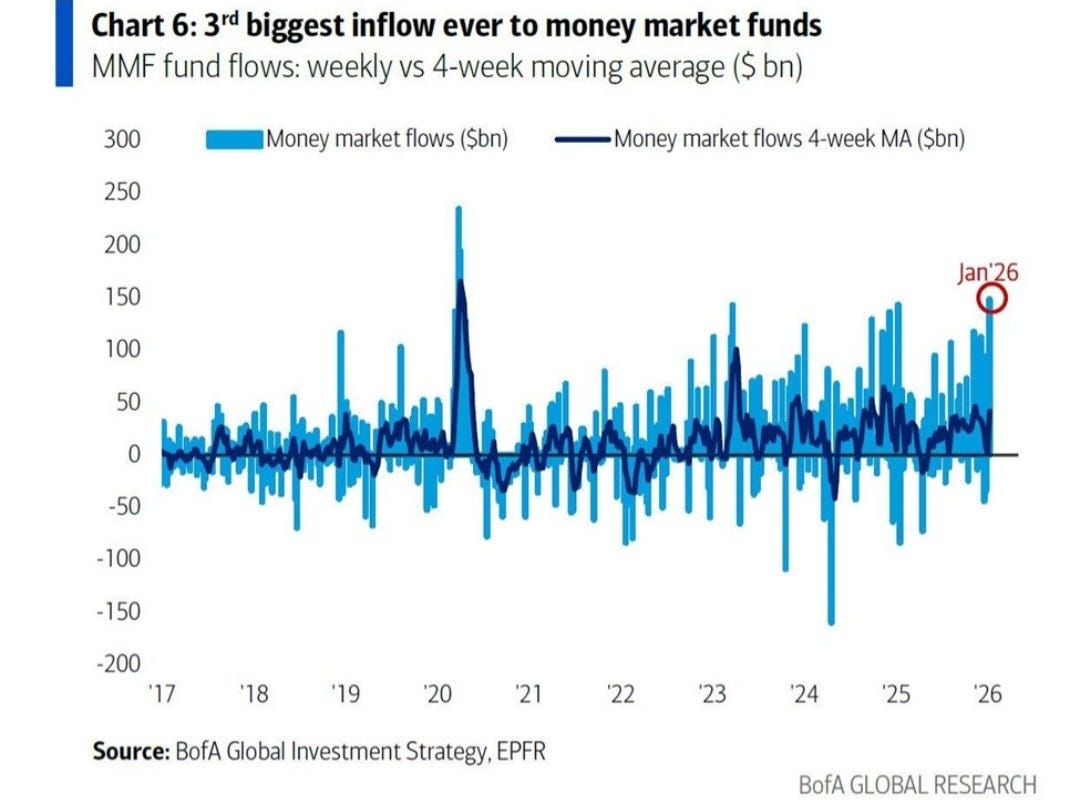
This is the largest pool of capital paralysis in the history of modern finance.
